Blog
What Makes a Computer Rugged? MIL-STD-810 and IP Ratings Explained
Teguar Editorial Team · June 18, 2026
"Rugged" is one of the most abused words in computing — slapped on anything with a metal case. But ruggedness is a measurable engineering property backed by real test standards. This paper explains what actually makes a computer rugged, how MIL-STD-810 and IP ratings quantify it, how to read the claims critically, and how to match a rugged spec to your environment without overpaying.
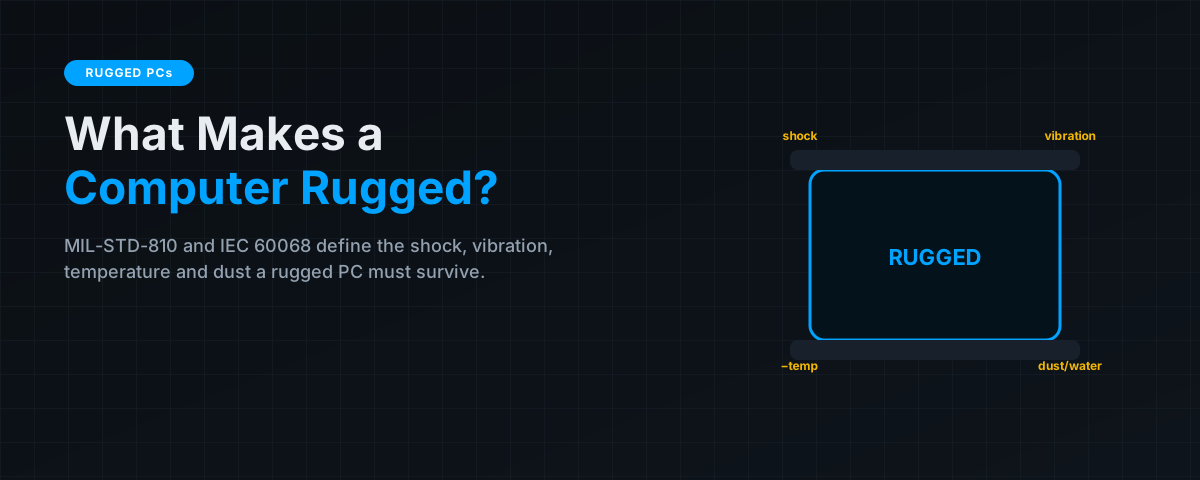
A genuinely rugged computer isn't defined by how it looks — it's defined by what it has been tested to survive. The difference between a thick plastic bezel and a certified rugged system is a documented set of test methods for shock, vibration, temperature, humidity and ingress. Learn to read those, and you can tell engineering from marketing at a glance.
Key takeaways
- Ruggedness is built on four pillars: mechanical survivability (shock/vibration), thermal tolerance (wide temperature), ingress protection (dust/water), and solid-state, moving-part-free construction.
- MIL-STD-810 is the dominant methodology — a family of environmental test methods for shock, vibration, temperature, humidity, altitude and dust.
- IP ratings (IEC 60529) quantify dust and water ingress; wide-temperature ratings quantify thermal range — always ask for the specific numbers.
- Read claims critically: MIL-STD-810 is a test methodology, not a pass/fail certificate, so ask which methods and procedures were run and to what levels.
The four pillars of a rugged computer
Ruggedness is not one property but four, working together. A computer is rugged to the extent it survives mechanical stress, temperature extremes, ingress of dust and water, and the absence of fragile moving parts.

Mechanical survivability: shock and vibration
The most visible pillar is surviving physical stress — drops, impacts and constant vibration from vehicles or machinery. This is where MIL-STD-810 does most of its work. It defines standardized methods such as Method 516 (shock) for drops and impacts and Method 514 (vibration) for sustained and random vibration. A rugged computer achieves this through a rigid chassis, board-level reinforcement, shock-mounted or solid-state storage, and locking connectors that won't shake loose.
MIL-STD-810 is a methodology, not a certificate. "MIL-STD-810 tested" is meaningless without specifics. Ask: which methods and procedures, at what levels, and was it independently tested? A vendor confident in their product will tell you.
Thermal tolerance: wide temperature
Rugged computers routinely operate in unconditioned spaces — vehicles, outdoor cabinets, cold stores, hot process areas. Thermal ruggedness means a specified wide operating-temperature range (commonly −20 to 60 °C, and −40 °C for extreme designs), achieved with fanless designs, wide-temperature-rated components, and industrial storage. MIL-STD-810 Methods 501/502 cover high and low temperature; the number that matters to you is the guaranteed operating range on the datasheet.
Ingress protection: dust and water
The third pillar is keeping the environment out, quantified by the IP rating (IEC 60529). A rugged computer for a dusty or wet setting should be dust-tight and water-resistant to a level matching the hazard — IP65 for dust and spray, up to IP69K for high-pressure washdown. We cover this scale in detail in IP69K vs IP67 vs IP66. Ingress protection is also where MIL-STD-810 Method 510 (dust/sand) and the IP standard overlap.
Solid-state, moving-part-free construction
The quiet fourth pillar: every moving part is a fragility. Rugged computers eliminate them — solid-state storage (M.2/SSD) instead of spinning disks, and fanless cooling instead of fans. Fewer moving parts means fewer things to fail under shock, vibration and dust, which is why the most rugged systems are both fanless and diskless.
Reading rugged claims critically
Put it together into a short due-diligence checklist:
- Get the specific IP rating — not "water-resistant," but IP65/IP67/IP69K.
- Get the operating-temperature range — the guaranteed numbers, with margin for your worst case.
- Interrogate the MIL-STD-810 claim — which methods and procedures, at what levels, tested by whom.
- Confirm solid-state, fanless construction for shock and dust resilience.
- Match to the environment. Vehicle mount → prioritise vibration and wide temp; washdown → prioritise IP69K; drops → prioritise shock ratings. Don't pay for extremes you'll never meet.
The bottom line
A rugged computer is defined by tested survivability across four pillars — mechanical (MIL-STD-810 shock and vibration), thermal (wide temperature), ingress (IP rating), and solid-state, fanless construction — not by a thick case. Treat MIL-STD-810 as a methodology to interrogate, insist on specific IP and temperature numbers, and match the spec to the real hazards of your environment. Do that and you'll buy proven ruggedness instead of the word. Explore rugged industrial computers such as the REGIS TB-7393, and see how ruggedness enables edge compute in our GPU edge AI guide.
Frequently asked questions
What makes a computer 'rugged'?
Tested survivability across four pillars: mechanical (shock and vibration per MIL-STD-810), thermal (a wide operating-temperature range), ingress protection (an IP rating for dust and water), and solid-state, fanless construction with no fragile moving parts.
What is MIL-STD-810?
A US military family of environmental test methods for shock (516), vibration (514), high/low temperature (501/502), humidity (507), altitude (500) and dust (510). It's a test methodology, not a pass/fail certificate.
Is 'MIL-STD-810 tested' enough to trust?
Not by itself. Because it's a methodology, you should ask which specific methods and procedures were run, to what levels, and whether testing was independent. Specifics separate engineering from marketing.
How do IP ratings relate to ruggedness?
IP ratings (IEC 60529) quantify the dust and water ingress protection pillar — e.g. IP65 for dust and spray up to IP69K for high-pressure washdown. They complement MIL-STD-810's mechanical and thermal methods.
Why are rugged computers usually fanless and diskless?
Every moving part is a point of fragility. Solid-state storage and fanless cooling remove the parts most vulnerable to shock, vibration and dust, so the most rugged systems eliminate both.