Blog
IP69K vs IP67 vs IP66: Which Washdown Rating Do You Actually Need?
Teguar Editorial Team · June 25, 2026
Higher IP numbers are not automatically "better" — they certify protection against different hazards, and a unit built for one can fail at another. If you are specifying a computer or monitor for a wet, dusty or washdown environment, this paper explains exactly what IP66, IP67 and IP69K test for, why IP69K is a fundamentally different animal, how IP relates to the NEMA ratings you'll also see quoted, and how to match the rating to your real-world conditions.
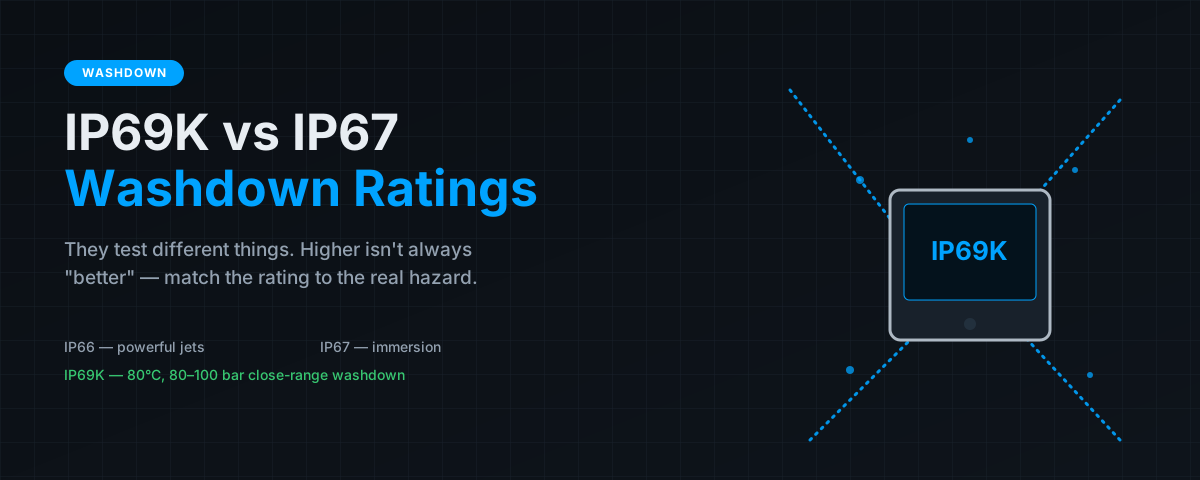
The single most common specification mistake in wet-environment computing is treating the IP scale as a simple ladder where a bigger number is always safer. It isn't. The two digits in an IP code measure two independent things, and the second digit is not strictly cumulative — a device rated for temporary immersion (IP67) is not necessarily protected against a close-range high-pressure hot-water jet (IP69K), because those are different tests simulating different hazards. Getting this right is the difference between a computer that survives daily sanitation and one that fills with water on its first wash-down.
Key takeaways
- In an IP code the first digit is protection against solids/dust (0–6) and the second is protection against water (0–9K).
- IP66 = dust-tight + resists powerful jets. IP67 = dust-tight + survives temporary immersion. IP69K = dust-tight + survives close-range, high-pressure, high-temperature washdown.
- IP69K (defined by ISO 20653) is tested with ~80 °C water at 80–100 bar from 10–15 cm at four angles — conditions ordinary IP67 immersion testing never applies.
- Match the rating to the hazard: IP66 for dust and hose-down, IP67 for immersion/outdoor, IP69K stainless hardware for food, beverage and pharma sanitation.
The IP code, decoded
"IP" stands for Ingress Protection, defined internationally in the IEC 60529 IP-code standard. The two characters after it are read independently:
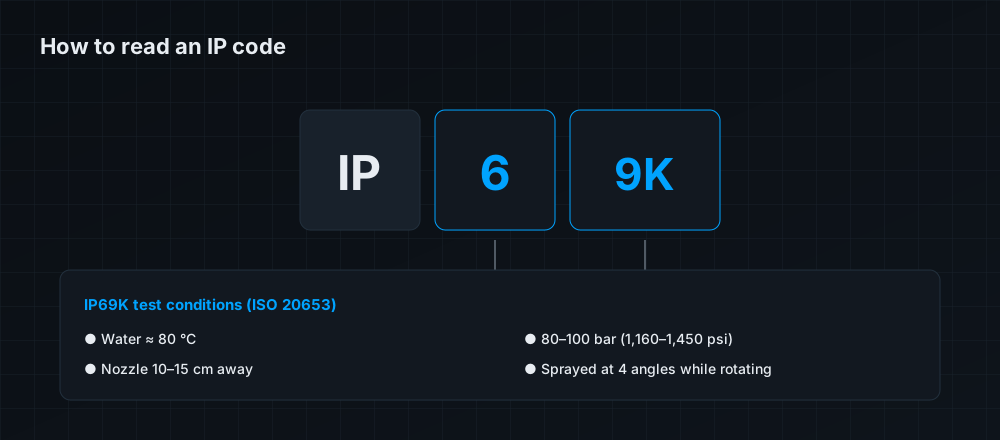
The first digit runs 0–6 and rates protection against solid objects and dust, where 6 is fully dust-tight. The second digit runs 0–9K and rates protection against water, escalating from dripping (1) through jets (5–6), immersion (7–8), to high-pressure washdown (9K). Because the digits are independent, "IP66" and "IP67" both start with a dust-tight 6 but diverge entirely on water: one is about jets, the other about immersion.
The three ratings compared
| IP66 | IP67 | IP69K | |
|---|---|---|---|
| Dust (1st digit) | 6 — dust-tight | 6 — dust-tight | 6 — dust-tight |
| Water (2nd digit) | 6 — powerful jets | 7 — temporary immersion | 9K — high-pressure/high-temp washdown |
| Test, in brief | 12.5 mm nozzle, ~100 l/min jets from any direction | Immersion to 1 m for 30 min | ~80 °C water, 80–100 bar, 10–15 cm, 4 angles, rotating |
| Simulates | Hose-down, heavy rain, wave splash | Brief submersion, outdoor exposure | Industrial sanitation / pressure washing |
| Typical use | Dusty floors, outdoor kiosks, marine decks | Occasional immersion, outdoor fixed installs | Food, beverage, pharma, commercial kitchens |
Note the crucial subtlety: IP67 immersion does not guarantee IP69K washdown performance, and vice-versa. Immersion is a low-pressure, room-temperature test; washdown is a high-pressure, high-temperature one. Truly demanding environments sometimes specify a compound rating (for example IP66/IP69K) precisely because each digit covers a hazard the other does not.
Why IP69K is a different animal
IP69K originated in the German DIN 40050-9 automotive standard and is now defined internationally under ISO 20653. The test is deliberately brutal: the device is sprayed with water at roughly 80 °C, at a pressure of 80–100 bar (about 1,160–1,450 psi), through a fan-jet nozzle held just 10–15 cm away, from four angles (0°, 30°, 60°, 90°) while the unit rotates on a turntable. That combination — heat, pressure and close range — mirrors what a sanitation crew actually does to a food-line surface at the end of a shift.
Ordinary IP67 immersion testing never applies heat or pressure. That's why a unit can pass IP67 and still be destroyed by a washdown wand — and why washdown-area hardware is built to IP69K, not just IP67.
Meeting IP69K drives the whole design. It is why washdown computers are built into sealed stainless-steel enclosures with continuously welded or gasketed seams, sealed connectors, and a flush projected-capacitive touchscreen — there is simply no other way to keep 100-bar hot water out. Those same units almost always meet NEMA 4X as well.
IP versus NEMA 4X
North American datasheets often quote NEMA ratings alongside (or instead of) IP. They are related but not identical: NEMA ratings additionally consider corrosion, icing and gasket durability, while IP is purely about ingress. As a practical mapping, NEMA 4X (hose-down + corrosion resistance) corresponds roughly to IP66, and washdown stainless hardware typically carries both NEMA 4X and IP69K. If a spec lists only one, it is reasonable to ask for the equivalent so you can compare vendors on the same axis.
Which rating do you actually need?
Choose by the worst thing that will realistically happen to the device, not by the biggest number available:
- Dusty floors, occasional hose-down, outdoor kiosks → IP65/IP66 front-bezel hardware is sufficient and more economical.
- Temporary immersion, wet outdoor fixed installs → IP67.
- Hot, high-pressure, chemical sanitation (food, beverage, pharma, commercial kitchens) → IP69K stainless hardware — nothing less will survive the wand.
Over-specifying has a real cost: IP69K stainless units are heavier and more expensive than a sealed IP65 panel PC. If your line is never pressure-washed, you are paying for a test your environment never runs. Under-specifying has a worse cost — a flooded computer and an unplanned line stop. The goal is to match, not to maximise.
Beyond the rating
An IP69K number is necessary but not sufficient. For a washdown deployment also confirm the enclosure is 304 or 316L stainless steel (316L for harsher chemical/coastal environments), that it is fanless with no vents at all, that cable entries use sealed M12-style connectors or gland plates, and that the mounting hardware itself is stainless. See our washdown computing guide for the full deployment checklist, and browse stainless steel computers such as the TS-7010-22, an IP69K, NEMA 4X unit built for daily sanitation.
The bottom line
Read IP codes as two independent measurements, not a single ladder. IP66 protects against dust and powerful jets, IP67 adds temporary immersion, and IP69K — a different test entirely, under ISO 20653 — certifies survival of close-range, high-pressure, high-temperature washdown. Match the rating to the real hazard: most environments are well served by IP65/IP66, immersion risks call for IP67, and only genuine sanitation washdown demands IP69K stainless hardware. Specify the rating your environment actually produces, verify the stainless grade and sealed connectors behind it, and you'll buy a computer that survives the wash instead of one that merely sounds like it should.
Frequently asked questions
Is IP69K better than IP67?
For washdown, yes — but they test different things. IP67 covers temporary immersion at low pressure and room temperature; IP69K covers close-range, high-pressure, high-temperature jets. A unit can pass one and fail the other, which is why demanding specs sometimes require both.
Do I always need IP69K?
No. IP69K is only necessary for high-pressure, high-temperature sanitation washdown (food, beverage, pharma). For dusty floors and hose-down, IP65/IP66 is enough and more economical.
What does the 'K' in IP69K mean?
It denotes the specialised high-pressure/high-temperature washdown test originally from the German DIN 40050-9 standard, now defined internationally under ISO 20653 — distinct from the base IEC 60529 water digits.
Is IP69K the same as NEMA 4X?
They overlap but aren't identical. NEMA 4X also accounts for corrosion and gasket durability, while IP measures only ingress. Washdown stainless units typically carry both NEMA 4X and IP69K.
What are the IP69K test conditions?
Water at roughly 80 °C sprayed at 80–100 bar (about 1,160–1,450 psi) from a nozzle 10–15 cm away, at four angles (0°, 30°, 60°, 90°) while the device rotates.