Blog
304 vs 316L Stainless Steel Computers: Which Grade Do You Need?
Teguar Editorial Team · May 4, 2026
Washdown and hygienic computers are built from stainless steel — but not all stainless is equal. The two grades you'll see are 304 and 316L, and the difference between them is corrosion resistance in the presence of chlorides and harsh chemicals. Choosing the right grade protects your investment; choosing wrong invites pitting and rust.
Stainless steel resists corrosion because of a passive chromium-oxide layer — but that protection has limits, and chlorides (salt, many sanitisers, coastal air) are its main enemy. The jump from 304 to 316L is essentially buying more resistance to exactly that attack. Whether you need it depends entirely on your chemistry and environment.
Key takeaways
- 304 is the standard, cost-effective stainless grade with good general corrosion resistance.
- 316L adds molybdenum for much better resistance to chlorides (salt, sanitisers, coastal air) and pitting; 'L' means low-carbon for weld corrosion resistance.
- Choose 316L for aggressive washdown chemicals, salt/brine, coastal, marine and pharma; 304 is fine for many general food and indoor uses.
- 316L costs more — specify it where the chemistry demands, not by default.
See the difference
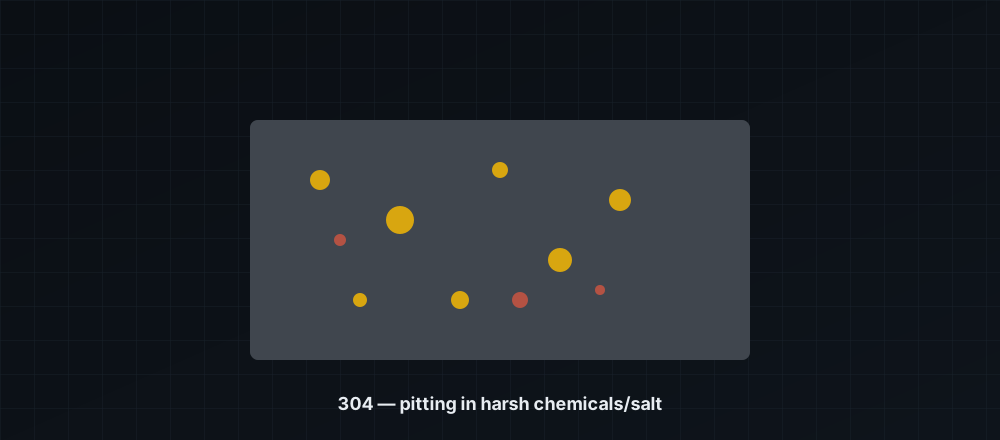
 304316L
In chloride-rich environments, 304 can develop pitting and rust while 316L resists corrosion. · drag to compare
Both grades look identical when new. The difference shows up over months of exposure to the wrong chemistry: 304 can begin to pit and stain where chlorides break down its passive layer, while 316L — thanks to added molybdenum — holds up. The "L" (low carbon) also reduces the risk of corrosion at welds, which matters for a fabricated enclosure.
Which grade for which environment
| Environment | Recommended grade |
|---|---|
| General indoor food prep, dry-ish areas | 304 usually sufficient |
| Regular washdown with mild detergents | 304 or 316L per chemistry |
| Aggressive sanitisers, chlorides, brine | 316L |
| Coastal / marine / high-salt air | 316L |
| Pharmaceutical / high-purity | 316L |
The deciding factor is chlorides, not just 'is it wet.' Salt, seawater, brine and many sanitising chemicals are what push you from 304 to 316L. If your cleaning chemistry or location is chloride-heavy, specify 316L.
How to specify
Identify your actual cleaning chemicals and environment (especially salt and chloride exposure), then choose the grade that matches — 304 where general resistance suffices, 316L where chlorides or purity demand it. Pair the grade with the right IP rating (typically IP69K for washdown) and sealed connectors, since the enclosure is only as good as its weakest seal. Browse sealed stainless steel computers such as the TS-7010-22.
The bottom line
304 and 316L look the same but differ where it counts: 316L's molybdenum gives it markedly better resistance to chlorides and pitting, and its low carbon protects welds. Specify 316L for aggressive sanitisers, salt, coastal and pharma environments, and 304 where general resistance is enough — matching grade to chemistry rather than defaulting either way. Combine it with the right IP rating and sealing for a washdown computer that lasts.
Frequently asked questions
What is the difference between 304 and 316L stainless steel?
316L contains added molybdenum, giving it much better resistance to chlorides (salt, sanitisers, coastal air) and pitting than 304. The 'L' means low carbon, which reduces corrosion at welds. 304 is the standard, more economical grade with good general corrosion resistance.
Which stainless grade do I need for washdown computers?
It depends on chemistry. Use 316L for aggressive sanitisers, chlorides, brine, coastal/marine air and pharmaceutical settings. 304 is often sufficient for general indoor food prep and milder washdown.
Why is 316L better against corrosion?
Its molybdenum content strengthens resistance to chloride attack, the main cause of pitting and rust in stainless steel, and its low carbon content reduces corrosion at welded joints.
Is 316L worth the extra cost?
Where your environment is chloride-heavy — salt, brine, coastal air, harsh sanitisers or pharma — yes, because 304 can pit and rust there. In milder, drier environments 304 is a cost-effective choice.
Does stainless grade replace an IP rating?
No. The grade determines corrosion resistance; the IP rating (e.g. IP69K) determines dust and water sealing. A washdown computer needs both the right grade and the right IP rating with sealed connectors.